

The Phases of Isolation

By Natasha Rasaratnam 

Phase 1: Relief

The day I received the email that we were off placement for the next two weeks, I was overjoyed! Maybe it had something to do with the fact that I was close to burnout and this was the closest thing I would get to a mid-semester break. Maybe it was because I was a great deal behind in my studies. Or maybe an excuse to stay in bed and watch Netflix seemed like a blessing in disguise.

Phase 2: Self-motivation

As quarantine started to become more than just a two week ordeal, social media was blowing up with self-help articles. Inspired by the countless, “Here are 10 things to do in isolation,” I found myself with a new motivation to self-improve during this time. How many times had I said, “I wish I had the time to read again” or “I wish I had the time to exercise,”? Now there was no excuse to not complete my wish list. The next thing I knew, I was doing crunches on my bedroom floor as I tried to ‘Get Abs in 2 weeks’ thanks to Chloe Ting.

Phase 3: A Creature of Habit

Let’s just say that I did not make it through the whole two weeks, not even close. My motivation to try new things lasted a maximum of three days. I found myself a creature of habit, returning to my sanctuary of Netflix and YouTube. Instead of becoming the MasterChef I always wanted to be, I racked up an impressive amount of completed TV shows that I had binged.

Phase 4: Loneliness

As the weeks started to all combine together to become an endless cycle of day and night, I found myself yearning for human interaction outside my family. Soon I was dreaming about eating out, a trip to the shops, even the face-to-face interaction of tutorials after facing the awkward silences on Zoom tutorials. Though previously taken for granted, I soon came to realise how much I valued human interaction.

Phase 5: The Bubble

Yet despite the sudden mundaneness of life and everything seemingly coming to a halt, as soon as I turned on the news, the bubble I had created for myself burst. Maybe it was my way of avoiding the reason why I was in isolation in the first place, pretending that we were on an extended holiday rather than a government enforced quarantine. After all, it’s a bizarre scenario that sounds like something straight out of an apocalyptic film.

I think it can be easy for us to feel trapped in our own home, inside our own isolation bubble. It’s enough to drive anyone crazy if we lose perspective. But the truth is we’re lucky. We’re lucky that for most of us, the worst part of this entire situation has been that we’re stuck at home. We’re lucky that we’re able to self-isolate with a roof over our heads, Netflix to binge and a steady supply of food in our supermarkets. Compared to the rest of the world, Australia is in an enviable position.

Phase 6: Where to go from here?

Whilst it is important to look at the situation in a positive light, for many of us social distancing has been a challenge. The isolation bubble not only keeps us from the outside, but traps us inside with our own stress and anxiety. The same internet and TV we turn to for entertainment now broadcasts the virus almost 24/7.  The constant media coverage of infection and death rates only raises anxiety. Although we may be physically isolated, it is important to prevent emotional isolation. Whether it be through Facetime, Facebook or an old-fashioned phone call, it is important to stay connected.

Phase 7: The Light at the End of the Tunnel

Indeed, this is something we never expected, and I don’t think there is any ‘right way’ to do isolation. You don’t need to come out of this a reformed person with abs and a cooking repertoire. Instead, there are many lessons that we have already learnt from this experience that will make us all better doctors. Resilience and the ability to adapt to rapid changes will hold us fast in our future careers. Most importantly, we have recognised the power we have if we all work together. As we see the number of cases fall in Australia, it’s a positive sign that our communal effort to social distance has been effective. At last, there seems to be light at the end of the tunnel.

How to HSM: The Meteorologist

By Anonymous 

What is the most important way in which care of a patient is coordinated between the health care professionals working in this clinical unit?

The sudden crack of thunder rolled over the hills in the distance. Out of the window the storm raged on, the violent swinging of the tree branches and pelting down of rain was punctuated by the odd flash of lightning. The psychiatrist sat back in his chair, leather loafers rested on his desk, staring out the window, mesmerized by the vigour of the storm. It was not uncommon to catch him in moments of deep contemplation like this.

I lurked at the threshold of his office, unsure of whether I should interrupt. I started to raise my hand to knock against the open door, but he spoke before I had the chance to do so. “Take a seat,” he said, not turning away from the window. I took a seat at his desk and sat for a moment waiting for him to prompt further conversation. He slid his feet off the desk and swivelled his chair towards me. “You see that out there,” he said motioning to the spectacle outside. I nodded, unsure where this was headed. “That,” he continued, “is the human psyche. Majestic, unrelenting, but in part, destructive.”

“Uh huh,” I responded. After a final glance out the window, his attention returned to me and he asked:

“So, what can I do for you?”

“Well, I just had another question,” I replied, “about how patient care is coordinated amongst the team at this clinic.”

“Right,” he nodded, a hint of a smile playing on the edges of his mouth, “I’ve always been quite fascinated by how mundane the questions medical students ask me are.”

“Well its not really my question, it’s for-”

“Well the short answer is that its not coordinated,” he cut me off, “its all really very haphazard.”

“Okay. But surely an attempt at organizing is made-”

“Well we try to organize,” he said, cutting me off again, “but this is a community clinic for psychosis. Psychosis, by nature, is a deeply disorganized condition. I mean being disorganized of thought and speech are in the DSM criteria. Its very challenging for a psychotic patient to adhere to appointments, scheduling, treatment and medical advice. It really undermines most of our attempts to organize.”

“Well then,” I fought on, “so what initiatives are made, however ineffective they may be?”

“Well our case workers and psych nurses to a stellar job,” he explained. “They stay in touch with patients and their families, track their treatment and progress, and organize appointments accordingly. They do house visits, provide counselling when needed, and can seek out community initiatives, job seeking services and housing for patients when the timing is right.”

“So how does that relate to what you do?” I pushed.

“They collaborate with me.”

“In what capacity?”

“In a collaborative capacity.”

“Okay…” my voice trailed off. This was proving to be quite difficult. I was beginning to think he was deriving a sadistic pleasure from this intellectual hazing. I shifted uncomfortably in my seat. Maybe I ought to quit while I was ahead. But of his own accord he continued:

“Think of it like this,” he gestured at the window again, “psychosis is the storm. The patients are the residents of the affected area, they need to be evacuated. The case workers and psych nurses are the SES, they know how to escape in a logistical sense, but me, I am the meteorologist. I can foresee and identify the illness just as it begins to roll in. I can direct their efforts.”

“That’s quite poetic,” I nodded in agreement.

“I have to write that down,” he began to search his desk for a pen, “that has to make an appearance in my memoirs.”

“Thanks for answering my question,” I said as I began to move towards the door.

“Anytime”

“And good luck with the memoir”

“I’ll send you a signed copy,” he responded with a sly smile. I ducked out of his office and hurried away with a sigh of relief.

A Virtual Rally

By AMSA Crossing Borders 

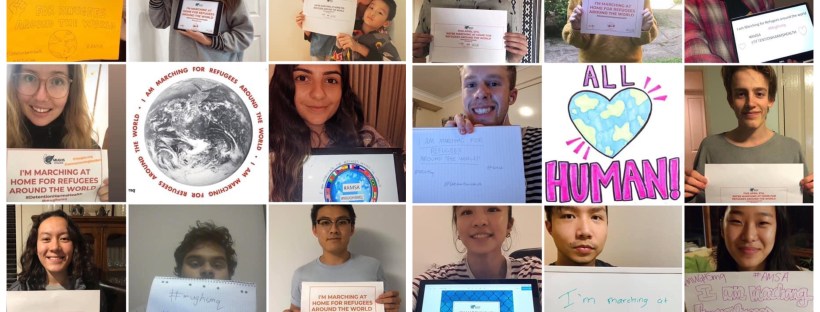
On Sunday, April 5, AMSA Crossing Borders called for refugees and people seeking asylum to be released from immigration detention centres into community detention, in an effort to protect this vulnerable population from COVID-19. Hundreds of Australian Medical students engaged in the virtual Palm Sunday Rally. Supporters shared photos of themselves holding up posters with the hashtag “#detentionharmshealth” on social media platforms in lieu of marching in person. The rally also went global, with Medical Students from many countries including Bangladesh, Qatar, Rwanda, India, Tajikistan and Indonesia joining through the International Federation of Medical Students Associations.

This year’s rally focussed attention on the impact of COVID-19 on refugees and people seeking asylum in Australia – particularly the risk of spread in detention centres and income support for those in the community. [1]

AMSA believes that all communities have the right to the best attainable health. In the current pandemic, the health of refugees and people seeking asylum in Australian detention facilities must not be neglected. AMSA therefore joins the Australasian Society for Infectious Diseases (ASID), the Australian College of Infection Prevention and Control (ACIPC) and Doctors for Refugees in calling for all detainees to be released from detention urgently to prevent rapid Covid-19 transmission. [2]

This is in line with AMSA’s policy on Refugee and Asylum Seeker Health, which takes the position that “it is unacceptable for Australia to sacrifice the physical or mental health of any refugee or asylum seeker in order to achieve other political or policy goals,” and

“The Australian Government must cease its practice of mandatory, prolonged, indefinite detention, in order to minimise the detrimental effects on refugee and asylum seeker health.” [3]

People in detention facilities are one of the groups most at risk of contracting the virus. The close proximity of living spaces and shared facilities is not conducive to adequate social distancing between detainees. As of 29 February 2020, there were 1440 people in Australian immigration detention facilities. [4]  Furthermore, the employees of the centres risk transmitting the virus between the detention centres and the wider community.  As Professor David Isaacs wrote in a recent petition to the Department of Home Affairs, “Failure to take action to release people seeking asylum and refugees from detention will not only put them at greater risk of infection and possibly death, it also risks placing a greater burden on wider Australian society and the health care system.” [5]

Current measures including “increased cleaning of communal, high-traffic areas and common touchpoints” [6] are, in our view, insufficient to prevent the devastating impact of an outbreak in any of the centres. The “absolute minimum necessary step” according to Australian Infectious Disease experts is that “detainees should be held in single rooms with their own bathroom facilities.” [7] Doctors for Refugees have an open letter with 980 signatories at the time of writing, calling the Government to start “immediately using alternatives to detention to provide those who are currently in immigration detention with appropriate alternative accommodation in the community.”[8] AMSA endorses the expert opinion that release is the most effective way to mitigate the health impacts on detainees and the public health of all Australians.

The Australian Medical Students’ Association (AMSA) is the peak representative body of Australia’s 17,000 medical students. AMSA’s Crossing Borders for Health is a transnational medical student initiative which aims to remove barriers to health care for refugees and asylum seekers.

Find out more about us and the Palm Sunday Rally through our social media outlets:

FB: AMSA Crossing borders

Instagram: @amsacrossingborders

[1] Palm Sunday Justice For Refugees – Virtual Event – 5th April 2020 – Social Media campaign and Online Actions. Refugee Action Network, 2020, April 4. Available from: http://www.refugeeadvocacynetwork.org.au/?p=1820

[2] Holt, R, Vasefi, S. ‘We are sitting ducks for Covid 19’: asylum seekers write to PM after detainee tested in immigration detention. 2020, March 24. Available from:  https://www.theguardian.com/australia-news/2020/mar/24/we-are-sitting-ducks-for-covid-19-asylum-seekers-write-to-pm-after-detainee-tested-in-immigration-detention

[3] Policy Document Refugee and Asylum Seeker Health Position Statement. Canberra: Australian Medical Students Association: 2019. Available from : https://www.amsa.org.au/sites/amsa.org.au/files/Refugee%20and%20Asylum%20Seeker%20Health%20%282019%29.pdf

[4] Immigration Detention and Community Statistics Summary, 29 February 2020. Department of Home Affairs: 2020, February 29. Available from:

https://www.homeaffairs.gov.au/research-and-stats/files/immigration-detention-statistics-29-february-2020.pdf

[5] Australian doctors call for refugees to be released amid coronavirus fears. SBS: 2020, April 2. Available from: https://www.sbs.com.au/news/australian-doctors-call-for-refugees-to-be-released-amid-coronavirus-fears

[6] Moore, S, Ton, W. Palm Sunday refugee rally goes online. AAP: 2020, April 5. Available from https://www.news.com.au/national/breaking-news/advocates-rally-online-for-refugee-release/news-story/cb1badfa60f92ae268761502865cdfbb

[7] Davis, J, Russo, P. ASID ACPIC Joint Statement COVID-19 and detainees. Australasian Society for Infectious Diseases: 2020, March 19. Available from: https://www.asid.net.au/documents/item/1868

[8] Open Letter to the Australian Government: Controlling COVID-19 in Immigration Detention and the Community. Doctors for Refugees: 2020, April 7. Available from:

https://docs.google.com/document/d/16M02AA9KvM1G45JM3iiP4xpP9JuAOzIEac8mneL03ms/edit?pli=1&fbclid=IwAR2rHeKMvISDkwape3QiSkTS3ae5UDD8SpY6946Sohw8KRSYquzdy6JcvcM