
A Guide To Increasing Productivity

By Maham Tasneem

As we all know, learning in medical school is like trying to drink from a fire hydrant. It can be overwhelming, especially, during these difficult times of COVID 19 where we’ve all been stuck at home. However, assignments, written exams, and OSCEs are still around the corner and we can’t lose our productivity. This article explores 7 different aspects every medical student should keep in mind to maximize productivity by encouraging a positive state of mind.

1) Inviting, comfortable, and clean workspace

No one wants to study in a dark, cramped, cluttered corner of the house. Therefore, it’s worth investing some time to clear up your study space; organise it; decorate it. When you wake up in the morning, you won’t dread starting your studies, but will be encouraged to get cracking on the day’s tasks.

2) Eating whole/healthy foods and exercise/keeping active

Many people have reported increased unhealthy snacking during the pandemic, especially when also having to study all day. Medical students work countless hours to finally become a doctor and take care of patients’ health. However, it is important that we do not forget our own health to better our ability in fulfilling our medical role. This can be achieved by regular whole meals and healthy snacks. On the same note, why not have a breath of fresh air as a break from studying. Take a stroll outside by the garden or by the beach shoreline.

3) Good quantity and quality of sleep

This is something medical student are notorious for not following. I know there is a lot to get done. However, in order to increase efficiency of daily tasks, it’s essential to get at least 7-8 hours of sleep. Think about the last time you had a good 8-hour night’s sleep (probably during the summer break) –  you’ll have woken up refreshed, energised and feeling like you can tackle anything in the world. You can feel like that everyday, and get a lot done by just prioritising your sleep. Oh and please don’t forget good sleep hygiene!

4) Keeping in contact with people

Though quarantine has put a hold on our regular social interactions. We can still continue to keep in touch with our loved friends and families through Skype and Zoom. Chatting with others helps reenergize yourself, which is always beneficial when trying to get on top of work. They’re also great in supporting you in being a medical student through these difficult times.

5) Having a life outside of medicine

The vast majority of people who are in medicine are obviously here because they love it and want to do this for the rest of their life. It is an absolute noble profession where you study day in and out for the betterment of people. However, it is also important not to get completely indulged where you forget about yourself and what makes you, YOU. So make some time for other interests you may have, whether it be photography, art, music, gardening, walks etc. You will feel like you haven’t lost yourself and will be even more motivated to continue thriving in the profession of medicine.

6) Creating a schedule

Now, you don’t have to create an over-the-top hourly schedule. A simple list of tasks that you want to complete for the day is more than enough. The idea here is to write everything down that you want to get done for both short-term (daily schedule) and long-term (monthly schedule) goals. This allows you to not think so much about the pile of work you have to get done by the end of the year, but keeps your mind focused on the short-term goals of the day. Ticks for each daily task are motivating for having a productive day. And then having ticks for each day that the schedule has been completed is also extremely satisfying to keep going for the rest of the month. Finally, at the end of the month, you can look back and admire how productive you were over the 30 days and restart the course of action for the next month.

7) Spirituality

Whether you are a Muslim, a Christian, an agnostic, or an atheist, spirituality is an important social factor in the contribution of health. Therefore it’s important to keep connected to your spirituality and community. There are many great Youtube videos, Instagram and Facebook pages, organisations, etc to support you. Overall, these will aid in creating a good personal state of mind to increase productivity. It’s a win-win situation! 
Sunsets

By Caroline Younan

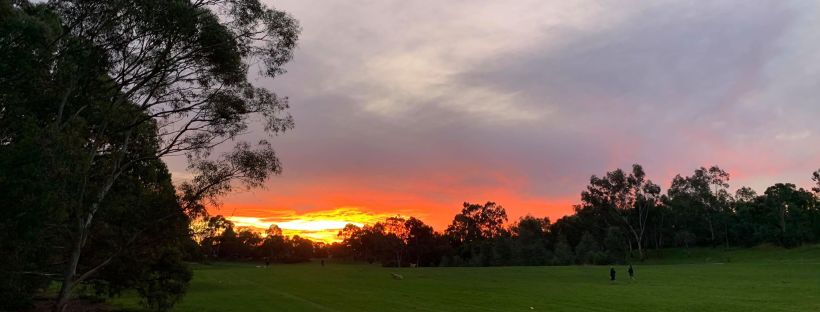
We may be in different places, and our individual 24 hours may look different, but we all have something in common. Every single one of us. Wherever we are, the sun will rise and the sun will set.

We all know the recipe to good health because we’ve heard it a million times:

  • A generous serving of good sleep
  • A splash of balanced diet
  • Sprinklings of exercise
  • And a dash of social connectedness is vital

What’s missing from the list? Yes, that’s right, I bet Craig Hassed’s voice popped up in your head with the cursed ‘M’ word, ‘mindfulness’. Whilst being in isolation, ‘tricks for mental well-being’ were constantly brought up and I, for one, have tried becoming the most ‘zen’ I can be with all this extra time. It became overwhelming though, trying to juggle all of these aspects at once.

Irrespective of how my day might’ve played out or how I was feeling, however, my constant was that I knew that I loved watching the sunset. There’s something about watching the transition between the light of day gradually turning into a pitch-black sky. It is grounding. It puts things into perspective for me and I realise how small we really are. Our worries can get the better of us sometimes and it can be hard to get away from our own thoughts. When I see the sky painted in different colours, it helps me breathe. I feel present. I feel calm. I feel grateful. Even when it’s been cloudy and the sky is grey you can observe where the sun is setting somewhere else, with that part of the sky tinted gold. This habit of watching the sunset daily allows me to catch those breathtaking views of pink, gold or, orange skies we see from time to time.

Where and how I watch it differs from day-to-day. Sometimes, I stand in my front yard or at the park nearby and sometimes I am walking along a trail. Regardless, I find that listening to songs complements the view and helps me calm down and focus on what’s in front of me. Lately, I’ve been listening to ‘Mystery of love’ by Sufjan Stevens but you might find it easier not to listen to anything and instead listen to nature’s sounds. Whatever you decide to do, this is a great way of informally practising mindfulness.

If listening to mindfulness podcasts seems like a hassle and like a chore that doesn’t fit into your day, I prompt you to watch the sunset. You’ll be amazed at how rewarding it can be to and how easy it is. It’s a great way to get a fresh breath of air if you find yourself spending a lot of time indoors.

Sometimes, you will be busy doing something else and that is okay too. There’s always the night sky to look at. I use an app called ‘SkyView Lite’ to identify planets and constellations that can be seen on a clear night. Sometimes, clouds will obscure the view, but don’t let this deter you. It’s more about the act of slowing down and looking up; taking a break from our busy day and busy minds. You could do this in the middle of the day as well and appreciate the sky as it is at that time. What does it look like?

It is humbling to realise that we all live under the ‘same roof’, despite our varied lives. It can be hard to implement the overwhelming advice that’s out there about how to live a ‘healthier’ life, but I prompt you to take these simple instructions. With our lives having moved online for the past few months, take your eyes off whatever screen you’ve been behind and go outside. Look up. Take in the scene.

Med Student Syndrome

By Mika Sood

I remember sitting in a lecture theatre learning about types of strokes – how it’s possible to have a brain aneurysm just sitting in your brain, how slowly the artery wall can weaken to the point that it can burst randomly and unprovoked and how it could, in theory, happen to anyone – including me. I don’t know why, but after learning more about it that day, I started to relate the symptoms to myself: “Do I have neck stiffness? Am I nauseous? I probably have a headache”. I could talk myself into thinking I had a brain aneurysm, and it wasn’t far-fetched at all.

I think we can all say that at some point so far in our medical education, all of the signs and symptoms begin to sound far too familiar as soon as we have studied a certain condition. This leads to a jump down the rabbit hole with a bit of help from Dr Google, and we self-diagnose ourselves with a condition or disease that had never crossed our minds before.

Medical Student Syndrome is defined as a condition frequently reported in medical students where they think they have the symptoms of a disease that they are studying. Don’t worry if this has happened to you – it’s significantly common and there have even been studies and research done about it. It has many names including “Third Year Syndrome” or “Disease of the Week”, but in essence, it’s a temporary kind of hypochondria based on being extremely aware of psychological and physiological dysfunctions and relating those signs and symptoms to oneself.

The wider community is also not immune to the effects of Dr Google, and in the age of this digital hypochondria, it’s important for us, as future doctors, to realise these effects for ourselves and the general population. It is true that you can find solid, evidence-based information online, but most Google research will not be directing you to the therapeutic guidelines. The easy access to health information is definitely convenient, and it is much less embarrassing than going in for a consultation to ask if it’s possible to have cancer and a brain aneurysm, but it’s also more than likely to be an incorrect diagnosis that can increase anxiety levels unnecessarily (1).

So, I guess this is a big red stop sign to get you to halt your daily activities and call out the irrational thoughts in your head. As medical students, it’s hard not to worry and stress about basically everything, but here is a little friendly reminder that you probably don’t have a life-threatening brain aneurysm or a rare deadly form of leukemia.

Take home message: Close all your google tabs. Stop self-diagnosing. I promise you don’t have the disease you think you do.

P.S. On a serious note, if you are really worried about something, definitely go see your doctor.


(1) MedicalDirector. Dr Google Survey 2019 [Internet]. MedicalDirector; 2019 [cited 2020]. 24 p. No: WHI00047Med – AUSV1. Available from: https://www.medicaldirector.com/resources/doctor-google