The Dead Teach the Living

By An Anonymous Author
Embolus feature May

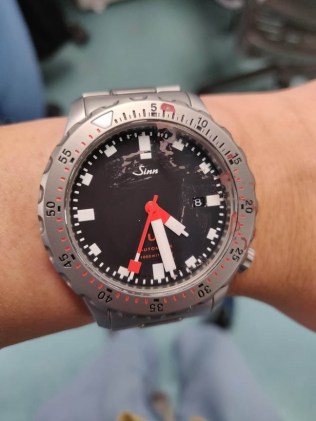
This picture was taken moments after resuscitation. The dried blood on the watch marks the time we took to save the man’s life. Yet, unfortunately, the patient passed away, alone in a room full of strangers he briefly met just forty minutes ago.

The patient arrived by ambulance, with the paramedics pumping on his his chest as we transferred him over to the gurney in the resuscitation room. The paramedics failed to intubate because of a difficult airway. Once the residents managed to intubate him, I was handed the task of ventilating the patient with a bag valve mask. I internally counted the intervals required to help the man breathe, squeezing the bag and watching his chest rise rhythmically as the doctors carried out chest compressions.

With each subsequent breath, however, he became increasingly difficult to bag, as if life was slowly escaping his limp body. And with each squeeze, blood would leak out from the small valve of the mask. Amidst the chaos, I watched as his blood trickled from my fingers down my forearms. It was as if he was falling apart in front of me.

“Time of death, four twenty-five,” declared one of the residents.

The desperate atmosphere of the resuscitation room became suddenly somber. As the residents left, thanking everyone for their help, I overheard a senior nurse asking one of the new nurses whether she’d prepared a body before. Watching the nurses quietly zipping the man into a body bag, I looked at the man’s face one last time. How lonely he was in his last moments without the company of his loved ones.

In clinical anatomy when we dissect cadavers, identify the landmarks, we are told, Mortui Vivos Docent, the dead teach the living. During our clinical years, armed with the anatomic and pre-clinical knowledge, we see the patients we serve pass away and recall what was once said to us, Mortui Vivos Docent, the dead teach the living. But in this case, the dead not only teach us the clinical knowledge, but the human aspect of medicine.

It seems amidst all the time we buried ourselves in books, we have lost the human touch to medicine and forget the humanity of those we serve. With our numbering days we spend in medical school, we realize that time flies so quickly as we look back into our youthful days. Yet, we have a hard time confronting the time in front of us dwindles just as quickly. The deaths of our patients not only teach us the things we could have done differently, but grounds us with the reminder to never abandon our patients and the humanity that embodies them.

And perhaps when we graduate, we will read this oath to re-affirm this promise we once made when we decided to commit our lives in service of others:

“At the time of being admitted as a member of the medical profession:
I solemnly pledge to consecrate my life to the service of humanity;
I will give to my teachers the respect and gratitude that is their due;
I will practise my profession with conscience and dignity;
The health of my patient will be my first consideration;
I will respect the secrets that are confided in me, even after the patient has died;
I will maintain, by all the means in my power, the honour and the noble traditions of the medical profession;
My colleagues will be my sisters and brothers;
I will not permit considerations of age, disease or disability, creed, ethnic origin, gender, nationality, political affiliation, race, sexual orientation, social standing or any other factor to intervene between my duty and my patient;
I will maintain the utmost respect for human life;
I will not use my medical knowledge to violate human rights and civil liberties, even under threat;
I make these promises solemnly, freely and upon my honour.” 


(World Medical Association’s Declaration of Geneva)


First published as an AMSA Embolus Feature

The work-life balance: myth or mantra?

By Megan Herson 

The mantra of achieving emotional, physical and spiritual happiness seems to echo throughout every facet of life. From social media and television, to work and study, it seems to be inculcated into our generation that it is necessary to find a way to equally incorporate social life, family connections, hobbies, physical activity, and spirituality into our lives in order to be happy.

Social influencers have been able to make an entire career out of posting photos about their seemingly perfectly balanced life. It was not until very recently that I realised that the components of achieving a balance in life actually makes quite a long list. How on earth am I able to engage in extra-curricular activities while I try to understand the difference between aortic stenosis and mitral regurgitation whilst simultaneously keeping up appearances at my friend’s social events, and remembering to get my daily dose of veges whilst I rush to gym to stay physically active? Just reading that sentence makes me anxious! The components of keeping a balanced life seem attainable, but cannot all necessarily be maintained at the same time. I am not saying that career, connections, physically health, and spirituality are unimportant, but rather that it is difficult to focus on all aspects equally without collapsing under the pressure. It is okay – even healthy (in my humble and not-yet-medical-professional opinion) – for work and life to be experienced unequally.

Having a perfect balance of work and life, in order to achieve a state of wellbeing, seems a fallacy to me. We are all at different life stages with different priorities. Placing more attention on one aspect of life at a time may actually support wellbeing by attenuating the stress of achieving everything in balance. If you are at a stage of life where focusing on career is more important to you than going to parties, you can focus on that aspect of life for a period of time. If you are in a stage where you need a break from driving career and want to focus on personal growth, it is okay to put more energy into spirituality, social connectedness and emotional wellbeing. Of course, it is always important to have some aspect of all components of wellbeing in play; however, it may not be possible to give a hundred percent of yourself to your career, physical fitness, spirituality and connectedness all at once. Acknowledge that you may not be able to balance every single aspect of what makes life ‘healthy’ equally all the time, yet you’ll still be able to make the best decision for yourself at that particular point in your life. The caveat is to remember to limit the amount of time that maximal attention is spent on one component of life, and to alter the focus depending on what your priority is during that period of time.


Here are my top tips for achieving a state of wellbeing from one type-A to another:

Let go of some of that medical-student-perfectionism. Okay, this is quite hypocritical because I find this difficult at the best of times… but perfectionism is unattainable, and you cannot give yourself completely to every aspect of your life at the same time. Focus on what you need at that stage of life. Balance is important, but it is impossible to manage everything that is important to you equally and at once.

Have a few phone-free hours every day. Constantly being on our phones makes us available to people every hour of every day, and makes the world available to us every hour of every day. A sense of urgency is thus created, with the constant need for instant gratification producing a need to rush through life rather than enjoying it slowly.

Be kind to yourself – a concept that is perhaps the most important yet hardest one to accept and accomplish. Acknowledging what you need to be happy – and putting your needs before others – not only identifies what your priorities are in life, making it easier to realise where your focus is needed, but also automatically makes you a happier person.

Finally, be kind to others. You never know what someone else is going through, and one seemingly trivial comment or act may have a disproportionate impact on another person. This has been said before but medicine is hard and it may not be possible to give it everything all the time, whilst juggling so many different things at once. However by supporting ourselves and each-other we can give it our best and enjoy the journey at the same time.


New Medical Student Screening Test Achieves 99.99 % Sensitivity

A Cannula Exclusive 

By Idew Wokefield

[De-identified] Hospital, Victoria – Medicine is a constantly evolving field with ground-breaking research allowing patients to be treated and diagnosed faster. Examples of such research has occurred in very stage of human history such as the 1928 invention of penicillin to treat bacterial infections, the 21st century mindfulness movement to treat burnout and the 15th century BCE ban on trepanning to treat ‘evil demon spirits’. However, despite hundreds of years of research and countless sums of money, people with disease or yet to be symptomatic from it are missed and suffer from the consequences such as a late cancer diagnosis. The Cannula is proud to report that a BMedSci student at [De-identified] Hospital has published a study that will allow human civilisation to enter a golden age akin to the introduction of pineapple onto pizza and has succeeded where countless centuries of the worlds brightest minds have failed.

The single blinded randomised control trial consisting of 300 ‘healthy’ participants utilises the ‘Medical Student Screening Test’ which is based on their unique self diagnosing abilities. When asked about how they invented this ingenious test, the unnamed BMedSci student commented ‘ I once attended an infectious diseases lecture and afterwards diagnosed myself with influenza, herpes and glandular fever. The next day I felt a little febrile with fatigue and an itchy throat and I promptly attended the GP. I told him my diagnosis and we had a 1-hour intellectual debate with him ultimately conceding that I was right and to “never come back to his clinic”. Afterwards I diagnosed my dad with colon cancer and the coloscopy removed a 0.3 cm hyperplastic polyp preventing his cancer diagnosis 40 years in the future.’ The experimental group is shown various lecture slides from the Monash Medicine Program consisting of the signs and symptoms and images of the post-mortem pathologies of hundreds of diseases. While the control group is shown first year slides displaying the Krebs Cycle. Both groups then fill in a 50-page survey, containing all the conditions known to humankind and ticking all the conditions they think they have. Afterwards every diagnostic tool is applied to them discover if they had any undiagnosed illnesses. ‘Basically, we perform an angiogram, 30 blood tests, a whole body X-ray, ultrasound, CT, plus biopsies of EVERY part of the body, a colonoscopy, a gastroscopy, a MRCP and all the physical examinations. Surprisingly the most common condition we diagnosed was white coat syndrome and hypochondriasis’ an unnamed researcher commented. Side effects experienced by the control group include, 28 participants passing out from boredom and one individual gaining an interest in biomedicine. Side effects experienced in the experimental group include 14 becoming naturopaths and 10 transferring their future care to Doctor ‘WebMD’. The results of the study show a remarkable 99.99% sensitivity and when asked about the specificity our unnamed hero exclaimed ‘it is in the 1st percentile for specificity in diagnostic tools’, a truly amazing result.

Our BMedSci student hopes to go to the Rxxxx Mxxxxxxxx Cxxxxxxx’s Hospital and to gain entry is currently working on a panacea that involves every treatment possible simultaneously because ’delayed treatment can be worse than delayed diagnosis’. The trial patients have a defibrillator applied, swallow a beta blocker tablet, inhale Ventolin, have IV Tazocin via cannula, have glycerol enema, whilst going through a meditation session with Monash HEP tutors to treat any potential anxiety. The Cannula reports that the potential panacea is achieving a patient centred approach with none of the trial patients lodging a complaint so far.


If you are a writer, fan, hater or corporate lawyer for [De-identified] Hospital, please send your ideas, money, hate mail or cease and desist letter to xxx1.spam.1xxx@gmail.com!