Intersecting Paths

BY RAY REN

The following piece received 1st place in the Visual Arts section of The Auricle’s 2021 Writing and Visual Art Competition and is responding to the prompt “The value of experience is not in seeing much, but in seeing wisely.” William Osler

In Chinese culture, the phrase “Fengshui” not only encapsulates spirituality, but emphasises self-reflection and inner study to achieve wisdom.

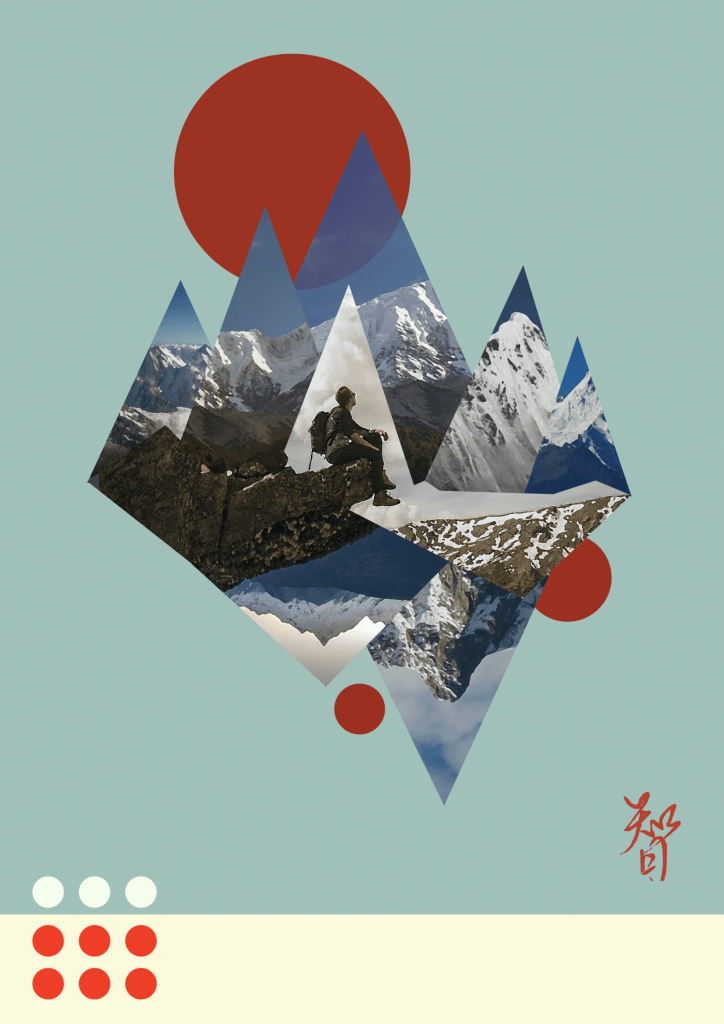
Inspired by my travels in Southwestern China through Yunnan and Tibet, this composition blends my love of hiking with art, photography and graphics design.

Faced with diverging paths at a crossroad, without a signal or cell phone, we were informed by the Sherpa that only one road led to our destination.

Much like the multifaceted paths that lay ahead, each triangle embodies a road through the snowy mountain. Embedded within are photos of our destination from afar. To our untrained eyes, each road appeared similar, albeit different. Likewise, each intersecting shape is simultaneously simple yet complex.

Ultimately, though many photos are captured, only one depicts the traveller at his destination. In the same way an experienced Sherpa guided us on that right path to the summit, the value of experience lies not in just seeing the choices that manifest in front – but in judging wisely.

Reflecting back on his wisdom, I realise that though my journey through med school is approaching its conclusion, there is still so much to learn from the experiences of the people and world around me.

Preservation

BY NATALIE EVANS

The following piece received 1st place in the Writing (Clinical) section of The Auricle’s 2021 Writing and Visual Art Competition and is responding to the prompt “Where the art of medicine is loved, there is also a love of humanity.” Uttered by Hippocrates millennia ago, has this adage stood the test of time?:”

Like Plath said –

about the woman in the ambulance,

our red hearts are meant to bloom through our clothes,

meant to bleed with the blood of lives lived, lives trying to live, lives failing,

picked for our hearts that bleed when patients bleed.

She talks of Poppies in October –

we pick poppies all year,

pick them on a sunny day and preserve them,

press them into notebooks and assignments,

almanacs of patient species.

Eyes cloudy with the frost of age,

skin so papery you can see blue rivulets,

that collapse in fright –

they’ve done this before.

He has had enough,

with each little stab he says so,

poppies are no ordinary bloom you see,

for you can fall asleep in poppy fields.

Students talk with one another,

human amphorae with facts to pour like wine,

spilling over the floor,

and we slip and tumble in it all.

History to the Anaesthetist and body to the Surgeon,

life sliced like an apple,

into neat little pieces of yes and no,

of midnight fevers and asthmatic wheezes.

How did we get here?

A timer ticks down and a bell rings,

what I want to know is, is there blood in the cough?

And why do I care? Now I remember.

You can suffocate on air,

when tar gluts your passages,

and you rip off the oxygen mask.

Yesterday I saw his wife.

We pick poppies all year,

pick them on a sunny day and preserve them,

press them into notebooks and assignments,

almanacs of patient species.

I don’t want to die – no gas cries the boy,

when you go to sleep it’s like you are dead,

I promise I’ll stay still – promise.

Needle pricks flesh and not even a flinch.

Wisdom comes from those,

who’ve travelled the same path before,

but found new ones as they walked,

in forests of past obscurity.

When knowledge comes,

and stays,

settling down in tired heads,

then the real work begins.

We pick poppies all year,

pick them on a sunny day and preserve them,

press them into notebooks and assignments,

almanacs of patient species.

You know it’ll fry my brain,

those electrode things and the seizures,

God wouldn’t like it.

We tell him God has no choice.

I’m eighteen and I want to help people.

Don’t say that,

everyone says that,

tell me, can you prove it?

Birth, life, death,

and then birth again,

humanity prevails in shrieks and wails,

and the brag of the heart I am I am S1 S2.

You cannot help without heart,

for the automaton sits in the corner,

it can tilt its head and extend its hand,

but it is cold to touch.

When did you start using?

Oh maybe twelve or thirteen,

for when people hit you,

you look for other kinds of hits.

On the street,

a woman begs for money,

it is for medication,

yes but what kind and I know and she knows and she goes.

Starry-eyed flirt when you start,

years pass,

as you fall in and out of love,

you think this romance might last.

Jigsaw people,

wheeled along antiseptic floors,

the pieces of the human puzzle,

all scrambled in our hive minds.

Missing pieces,

lurk within body and soul,

sometimes found,

mostly lost. 

Flicking through crumpled pages,

notes from the wards,

endless quotations,

wondering what did they mean?

We pick poppies all year,

pick them on a sunny day and preserve them,

press them into notebooks and assignments,

almanacs of patient species.

Will I get better?

Where do we go –

            in the end?
                        Who will we be -
             before then,
                         lost in a sea
                                    of maybe, 
                                                             of we’ll see.

Author’s Note: 

“Plath” refers to poet Sylvia Plath, and fragments from her poetry, ‘’Poppies in October’’ and, ‘’Tulips’’, as well as her novel, ‘’The Bell Jar’’, are referenced throughout the poem.
Choice

BY JAMES GUNASEGARAM

The following piece received 1st place in the Writing (Preclinical) section of The Auricle’s 2021 Writing and Visual Art Competition and is responding to the prompt “the pursuit of knowledge is a quintessential part of medicine, but the benefits and risks sometimes balance treacherously

I haven’t been in a clinic waiting room for years, and the longer I sit in this one the less I miss the experience. The walls are painted a shade of beige that reminds me of cardboard, this plastic chair feels like it might give out at any moment, and they told me to show up ten minutes in advance but they’re already fifteen late.

A mother and her son sit across from me, her flicking through a magazine from the small mountain on the coffee table between us and him engrossed in a novel. I squint at the cover, hoping it’s not too obvious as I try to discern the title. H…A….R…Harry Potter. I blink a little in surprise. He can’t be more than six or seven. Was I reading at all at that age, much less chapter books? I guess they teach it better these days.

The receptionist calls my name and my attention snaps back to my appointment. I gather my things, flash a polite smile at the others that both are too captivated to receive, and get up. A disembodied hand waves to me from the doorway of one of the consultation rooms. I follow it in, almost bumping into the short woman on its other end. She gives me a broad smile.

“Good morning – sorry about the wait. I’m Dr. Truong. Have a seat and we’ll get right to it.” She gestures to a chair in front of her desk and I lower myself into it, memories of school resurfacing at the constant little directions. She sits on the other side and shuffles a stack of papers as she begins to speak.

“Today we’re just going to go through some of the options you have from here. You can relay all this to your partner at home, and Greenfield IVF lets you make the choices right on their website. It’s all very stress-free.”

She glances up at me and waits for my small nod before continuing.

“Greenfield says they’ve had a successful fertilisation, so you have a viable embryo ready to go – a girl, if you’re interested. Before they let her progress further – how much do you know about gene editing?”

I rack my brain, sifting through hazy memories of high school biology. “…I remember enough. I’m not too fussed about the details.”

She nods, seeming a little unconvinced but either too polite or too indifferent to press it. 

“Right. Well, the important thing is that it’s easiest to make any changes at this stage, before the embryo has started dividing. So now’s where you’ll have to decide what you want them to do.”

Dr. Truong slides one of the sheets across the desk, a series of black-and-white lines highlighted here and there in angry red.

“You and your partner are both carriers for Cystic Fibrosis, and as it stands your child will inherit the disease. Greenfield offers single-gene disease protection as standard, so they’ll fix that up for you free of charge. There’s a few other nasty things they’ve spotted,” she reaches over and gestures to some of the other red highlights, each with a small disease name printed next to it, “which they’ll take out as well.” She leans back and smiles.

“Pretty cool, isn’t it? A couple decades ago we wouldn’t even have known until much later.”

“Yeah.” I smile back. My uncle had bad CF – I remember going to visit him in the hospital after he had a lung transplant when I was just a kid. I look over the sheet again and notice the title: “Section A – Genetic Diseases”. 

“Are there more sections?”

She withdraws another page from her pile, spinning it around on the tabletop as she slides it over to me. This one is much more lively, with large images covering the page and the title proudly sitting at the top left: “Section B – Enhancements.”

“This is some of the newer stuff. Tweaks to height, hand-eye coordination, IQ-“

Did I hear that right? I shake my head and frown slightly. “I’m sorry, what?”

“Oh, it’s not perfect. These are pretty complicated traits, so…”

She keeps talking, but I’m no longer listening. My eyes slide down the page, over neatly curated options to make your child perfectly smart, capable, talented. Everything you could ever want.

This feels… wrong. My gut tells me that humans aren’t meant to be perfect. We’re meant to be a little messy and rough and broken. Isn’t that what makes us human?

But the more I think about it, the more doubt creeps in. Maybe it’s so easy to cling to our imperfections as proof of our humanity because we’re messy and rough and broken, and we like to think we’re human. Not only human, but the best we can be. Maybe I don’t want to acknowledge that there might be better humans because it makes my own struggles seem pointless instead of heroic.

If I refuse the changes, will I be giving her the gift of humanity? Will she see it that way? Will she appreciate her imperfections when she needs braces? Will she feel more human for struggling through her times tables while her classmates are mastering violin? Or will she feel robbed of a better future because of my choice?

Dr. Truong finally seems to notice that she’s not getting through and stops. Her face contorts for a moment and she hesitates before speaking again.

“I mean, you could always go unmodified.”  

Unmodified. That word feels so insidious, transforming being… normal into a deficiency. Will her classmates feel the same way, raised with the knowledge that they’re better? Will they mock her as “unmodified”, with the casual venom children so easily employ?

Maybe normality is a burden in this new world. Isn’t my role as a parent to give her the best chance possible? Why shouldn’t this be part of it? I didn’t blink at curing a normal disease. Would she grow up feeling like her sluggish thoughts and little flaws were their own ailment?

Am I giving her a normal childhood, or holding her back from a better one?

“I… I’ll have to think about it.” 

I raise my gaze off the sheet and look back at Dr. Truong. She gives me a smile that doesn’t quite reach her eyes. I can see her flick her wrist as she reaches for her desk drawer, surreptitiously checking the time. There are more people to see, people who won’t be as stubbornly hesitant as me.

She pulls out a glossy pamphlet and slides it over. The picture on the front is a mother and her child. Perfect teeth. Perfect eyes. Perfect everything.

“This’ll explain a little more,” she says with the same customer-service smile. As if the problem was that I understood too little.

“Either way, your partner isn’t here today and we don’t recommend you make the choice alone. You don’t have to decide now. But you will have to decide.”

I offer her a hollow thanks, gathering the sheets as I stand. I have this wonderful, terrible power in my hands, and no idea how to use it.

Maybe it would’ve been better not to know.