
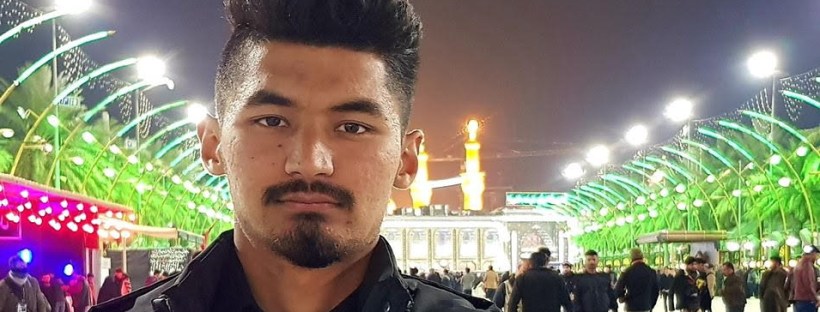
Humans of Medicine – Kumail Jaffry

Tell us a bit about yourself.

I’m a member of the Hazara people, an ethnic group in Pakistan, and I came to Australia with my family as a refugee. At the moment, I’m studying medicine in third year and doing my placement in Mildura where I grew up. I did my undergraduate degree in Biomedical Science back in Melbourne and lived away from my family. Now, I’m back in Mildura and I love the weather, I love the people – it’s really good to be back here. 

Outside of university, I used to volunteer for Monash Health, where I met a lot of refugees and people from different backgrounds. These days, I’ve found enjoyment in volunteering to teach young kids at a community school on Sundays, which is currently being run online due to coronavirus. I was asked to teach after helping out at Hazara community group services, and I think it’s given me more opportunities to improve my communications skills and get to meet new people. 

Could you explain a little of the situation facing the Hazara people in Pakistan?

Over the last ten to twenty years, we have seen many Hazara refugees coming to Australia from Pakistan because they are being persecuted by many terrorist organisations. They have suffered so much. I remember that in every street in the city [I came from], there have been people killed. I’ve lost people from my house, I’ve lost friends, my friends have lost their friends, and they’ve lost people from their houses. There’s not a single street that hasn’t lost someone. They’re constantly being persecuted, the Hazara, and now they’ve come to different countries like Europe, the US or Australia. A lot of them came to Dandenong, and there’s a big Afghan community there now.

What has your personal journey been like?

Like many of the Hazara who came to Australia to escape persecution and terrorism, I arrived here when I was very young with my family. I remember I didn’t speak any English. I went to a community centre in Mildura and then some of the secondary colleges, including Mildura Senior College, where I did my VCE. From there, I went to Monash University to study biomedical science and through that and volunteering for Monash Health, my love for medicine increased. And now I’m here.

What challenges did you face in Australia as a refugee?

It took a long time to learn English. When you first come to Australia and they put you in a mainstream school, it’s a bit difficult to understand the content, which resulted in disruption to my education. It took me around two years to actively engage with the community and start to become more fluent.

I also think not having an extensive connection with other people is something that affects a lot of refugees, even now. Although I was lucky to have access to a lot of other resources, there are asylum seekers who don’t have access to basic human rights such as the ability to go to the GP or use Medicare. I think that’s something that is detrimental to the health of a lot of asylum seekers.

Fortunately, in every step of my life my parents have had my back. Back in high school, I also had wonderful teachers who shared their life experiences and stories and guided me in what sort of path to take. I really appreciate that.

Are there any aspects of refugee health that the average student might not be aware of?

This is pretty relevant to me. In Mildura we’ve been seeing a lot of refugees coming in because it’s a small town, it’s easier to get around, it’s easier to get to know people and there’s a lot of organisations that can help you as a refugee. 

For example, the fact that a lot of the asylum seekers don’t have access to Medicare cards because their Visa applications have been rejected by the department is something that affects a lot of asylum seekers. Because of that, we’re seeing a lot of refugees coming straight to the ED instead of going through the usual process where a GP assesses you and decides whether your issue needs referral to the ED or other specialists. In Mildura, asylum seekers don’t have their Medicare card and don’t have access to healthcare. So they actually wait until their health deteriorates severely, and then come to the ED straight away without going to the GP. I think that’s something that negatively impacts the hospital, Australia overall, and the health of the asylum seekers themselves.

What has been your favourite moment in medicine so far?

On my first day at clinical placement in Mildura, I was allocated to the general surgery division and I was asked to scrub in. The first patient was a two-year-old who presented with hernia. It was my first time being part of that surgery. I was a bit nervous given the circumstances, but I got through it in the end with the help of my registrar. 

I had never been a part of a surgery before and to be helping a surgeon do a procedure on a two-year-old – it touched me emotionally. That’s something I keep in mind, and which has sparked my interest into possibly doing surgery in the future.

Where do you plan to take your career?

The relationship that I’ve made with Mildura is just wonderful, and I’d love to come back. Recently, we’ve lost a huge amount of doctors in Mildura, which is, of course, a bad thing for the community. I hope to see a lot of doctors coming back in the future, and would love to be part of that movement. The top two specialties I’ve got on my list are general practice or being a general surgeon.

I’m loving what I’m doing at the moment. There’s not a day that I feel 100% confident about my knowledge in medicine. I’m always thinking back and reflecting on the times that I didn’t know things in hospital. So I’m always learning, and I love that about medicine.

What changes would you like to see in medicine?

The hierarchy that we see in hospital. The structure is understandable, because someone needs to be responsible for everything that is happening with the patients, and that chain from the consultant down to the registrars and the interns and so on is how we do it. I do, however, think that the healthcare system would benefit from a more horizontal structure, so that we don’t approach medicine with such a rigid chain of command.

Artificial Intellect

BY SARAH STEVE 

 “I’m Sarah. I’m a medical student.” these are the first two things people I meet learn about me.

‘Sarah’ – it’s simple, there’s not much to gain from that and ‘Medical student’ which means, “oh you’re obviously smart,”  stated with an indecisive look considering if they should admire me or run in case they might catch the disease as well.

‘Well we’d hope so wouldn’t we.”

Knowing what I do of myself, I’m just as surprised as they are that someone would give me this much responsibility. But they did, so maybe I need to get over it…. I am smart – or at least very good at making a lot of smart people think I am.

“Hi, my name is Sarah and I am a second year Medical Student from Monash University. Your GP today has asked me to…” Name. Brand. Product. This is how I am presented.

They don’t teach you the robotic voice to go with it, this comes naturally, maybe not naturally but eventually.

Maybe not naturally but eventually.

Maybe not naturally but eventually.  

See how annoying that is? – believe me, it doesn’t become any less annoying if you’re the one responsible for the line. I am smart. I am a fragile input and output system. With time, I will become more impersonal, more detached and less human.  

Fighting to stay maintain a sense of identity and purpose – to remember why I wanted to do this in the first place is harder than I imagined.

And motivation? I chuckle at my naivety… ‘I just want to help people’ – those days are gone. I am driven by an abundance of stress. I frantically pore over the information and jargon. Somehow, I download everything onto my memory card in time for the exam.

We’re high achievers and perfectionists with an underlying mild to moderate case of OCD. Among our peers, a distinction equals recognition and a high distinction? That’s practically fame. We all want to be a limited-edition, to be part of an elite series – it’s not good enough to be good, we want to be the best.  

I am a Human replica of a Moore’s Clinically Orientated Anatomy ebook. I am filled with apparently connected, yet random, confusing facts disorderly and collated onto a mental hard drive… but my software is insufficient, I can’t keep up. Failed downloads and poor connection speed leads to a permanent state of confusion. I am told it will all make sense, it all comes together – but even these academics, intellectual giants and conquers of their field – they have their limits, they have unanswered questions… so what hope is there for me? How will I ever understand?

But I do understand. I must. The cogs continue to turn, the formulas, terms and foreign languages downloaded, filed and saved ready for recall.

To survive in this field I must breathe, drink, eat, sleep but above all study.

But to love my life – I don’t have a simple answer. I am determined not to get lost in the mechanics of this beautiful profession. Medicine pairs knowledge and technology to bring hope in hopeless health reports. Doctors daily to do what was impossible 10 years ago, sometimes what was impossible yesterday. Diseases once feared and millions died from are now history – We are creating history every day and I will be a part of this in some way or another.

However, I fear that as my optimism dissipates, the excitement and drive will be gone completely clouded by the mundane; mechanical routine, rounds and checks – eventually my software will malfunction.

Do you think one day you’ll be replaced by robots? That you’ll be put of a job? No, I more concerned that my endeavour to become an artificial intellect – to be perfect will render me obsolete, it will be the thing that ends my career, that kills me one way or another.

We were not born to be a machine even if we were, we need regular maintenance and product development – I can’t become a limited edition overnight, this prototype phase will be ahead of me for a while yet.

Medical breakthrough wasn’t launched by an app but by a person. I am a person; my network connections stretch beyond medicine. I need to open other tabs and search through other browsers. At times, I need to hit the reset button, get some air and pull out my sketchbook.  

I will try but I will never perfect the art of medicine. I will hurt people. People will die despite my best efforts, perhaps even because of them.

Regardless of my perfectionism, I cannot hold myself to an artificial standard because I am real.

I’m Sarah. I’m a Medical Student.

I’m a person who studies Medicine.  

You will never be successful if you have a mental illness

By Molly Maxwell

‘You will never be successful if you have a mental illness’. 

This was a lie that I had unknowingly been telling myself for the 5 years.

After a significant battle with mental illness in year 12, the trajectory of my life felt like it had changed forever, and I felt like I had made it out of school by the skin of my teeth. So I started on my daunting journey of leaving my depressive episode behind. In the years following, I was able to recover and put my past behind me. I felt well enough to pursue a science degree in the hopes that I could maybe…possibly… probably not, but maybe… get into medical school one day. I worked hard to relearn how to function and focus and learn and in December of 2019 my dream was realised when my frantic refreshing of the application portal yielded a successful result.

I immediately started bawling my eyes out, not because I was happy or relieved but because in that moment I had finally proved to everyone around me and myself that I was not a failure and that I was normal and that I was no longer the sad teenager who would never amount to anything.

But BOY  could I not have been more wrong. It took the first year of medical school and the wondrous quandaries that a global pandemic presents to show me that this was not at all the case.

Throughout the last 5 years, I put so much pressure on myself to remove my identity from that of the depressed teenager that I failed to let myself actually address the mental challenges that I continued to face. Looking back now, the obviousness of how my mental illness affected me is almost comedic, but my desire to be normal and my “high-functioning” outer shell prevented others and myself from noticing just how much I was struggling. In early lockdown, I began to spend hours each day ruminating on anxious thoughts that consumed me and once again took away my ability to focus, and learn, and care about almost anything; thoughts that couldn’t be brushed off as uni stress or friendship issues anymore.

Over the years, issues like this had occasionally seeped out. Times of high stress and traumatic events would cause my brain to overflow where I felt like I desperately needed help, but every time I could never follow through. This was all because subconsciously, I had believed that if I couldn’t get into medicine without help, I didn’t deserve to be there at all.

As I sat in isolation, I realised that not only was my mental illness becoming all-consuming but my inability to treat the problems that I was having for fear of never making it as a doctor may actually make me unwell enough to fail medical school and ironically, not become a doctor. So finally, I got help. I relinquished my internalised stigma towards mental health and medication and for the first time in my living memory I finally experienced not having every thought and action derived from some part of my illness. It was not easy but it was worth it and my only regret was that I hadn’t done it sooner.

I write this in the hopes that someone, maybe you, will read this and take this as a sign that you do DESERVE help. That help will not make you less successful or whole or talented or any number of the wonderful things that you likely are. Treat yourself how you would treat the ones you love the most and together we can begin to change the stigma of mental health in medicine.

Phone counselling service @ Monash

Call 1300 788 336 [1300 STUDENT]

Telephone counselling open 24 hours.

  • From Malaysia: 1800 818 356 (toll free)
  • From Italy: 800 791 847 (toll free)
  • From elsewhere: Students +61 2 8295 2917 | Staff +61 2 8295 2292

More information can be found here.

Or contact MUMUS Community and Wellbeing